How Cognitive Automation is Shaping the Future of Work

Tech Insights for Professionals
The latest thought leadership for IT pros
The future of work is currently being shaped by cognitive automation. But before you invest in AI technologies, it's crucial to know the difference between RPA and cognitive automation, and how they impact business processes.
15 March 2019
Cognition is one of the most outstanding capabilities representing the human species that help them succeed and achieve extraordinary challenges. In artificial intelligence, a cognitive system was developed mainly due to the explosion of unstructured data. However, these systems expand the human cognition boundaries instead of replicating or replacing them.
What is cognitive automation?
Cognitive automation refers to artificially intelligent software systems that learn rules, understand language, reason with purpose, and naturally interact with humans. They do not require explicit programming, instead they interact with their environment and learn from the experiences.
Cognitive automation is a sub-discipline of AI that combines the capabilities of human and machine. It uses various techniques to simulate human thought process, such as machine learning, natural language processing, text analytics, data mining, and pattern matching.
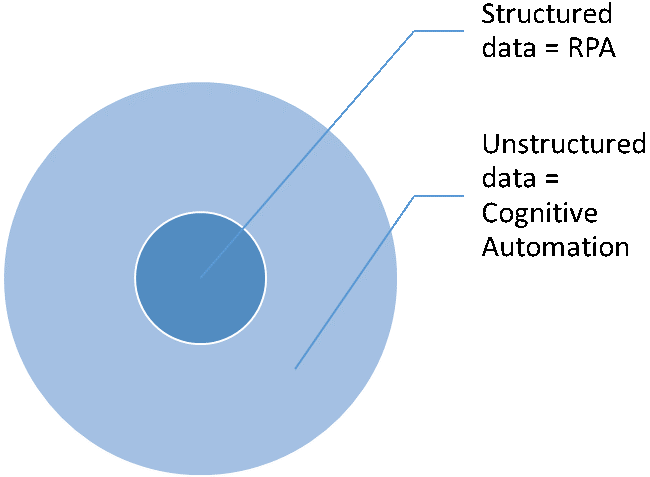
Unstructured data is difficult to interpret by rule or logic-based algorithms and require complex decision making. Intelligent/cognitive automation is a good way to take unstructured data, understand it, format it, and then pass it to the more traditional RPA bots to process at scale. It is a self-learning system that imitates the way a human brain works by going through the steps of observation, evaluation, and decision making.